Showing posts with label introductory. Show all posts

How to Interpret Transits


also How to get a Transit Chart
& How to Interpret Transits


How to get a Transit chart at astro.com

Ok, so now you have your transits chart and you downloaded the additional tables, as instructed in my previous post.  Now what?

The green planets outside the chart are the transiting planets. (See Key to the right)
Don't understand all the symbols?  
(We call them glyphs)

my transits
Excerpt from Additional Tables:
This chart shows the natal planets of the person across the top, and the transiting planets in the rows.  So for example, the current Sun (in the first row) is opposing my Mercury and Neptune, trine my Uranus and Pluto.  I usually just scan for the main aspects (conjunctions, trine, square and oppositions).
excerpt


Searching for Interpretations


You need to search for interpretations with the correct format:

"Transiting Planet to Natal Planet"  for example, "Transiting Saturn, Natal Moon"

You can also add the aspect "Transiting Saturn conjunct Natal Moon"

You also can look for "Transiting Planet in House"

Aspects:

In order to decipher the above charts, you need to be able to translate the Aspect symbols/glyphs.

Read more about Aspects here.

aspects

Or use this great book:


Planets in Transit: Life Cycles for Living 
by Robert Hand 
$23.91  

Also look for Retrogrades:


Introductory Astrology

Introductory Human Design
Lunation Calendars
and Calendar

FOLLOW BY FEEDBLITZ:
Your email address:

Powered by FeedBlitz


How to get a Transit chart at astro.com


Start with joining astro.com and creating a Natal Chart:

http://astrologicalcounsel.blogspot.com/2016/05/how-to-get-natal-chart-at-astrocom.html

Go to "Free Horoscopes" and "Extended Chart Selection" and choose "natal chart and transits":
choose "natal chart and transits"
 Right click and save your chart to your files:
also choose "Additional Tables"
Right click and save this PDF as well:
Add caption
Don't understand all the symbols?  
(We call them glyphs)


Introductory Astrology

Introductory Human Design
Lunation Calendars
and Calendar

FOLLOW BY FEEDBLITZ:
Your email address:

Powered by FeedBlitz


How to get a Natal Chart at Astro.com

http://astro.com

Go to Astrodienst:
astro.com
 Sign in as a guest or Join:
login
 Add new person:

Birth Data Entry 
Choose "Free Horoscopes" and "Extended Chart Selection"
Extended Chart Selection
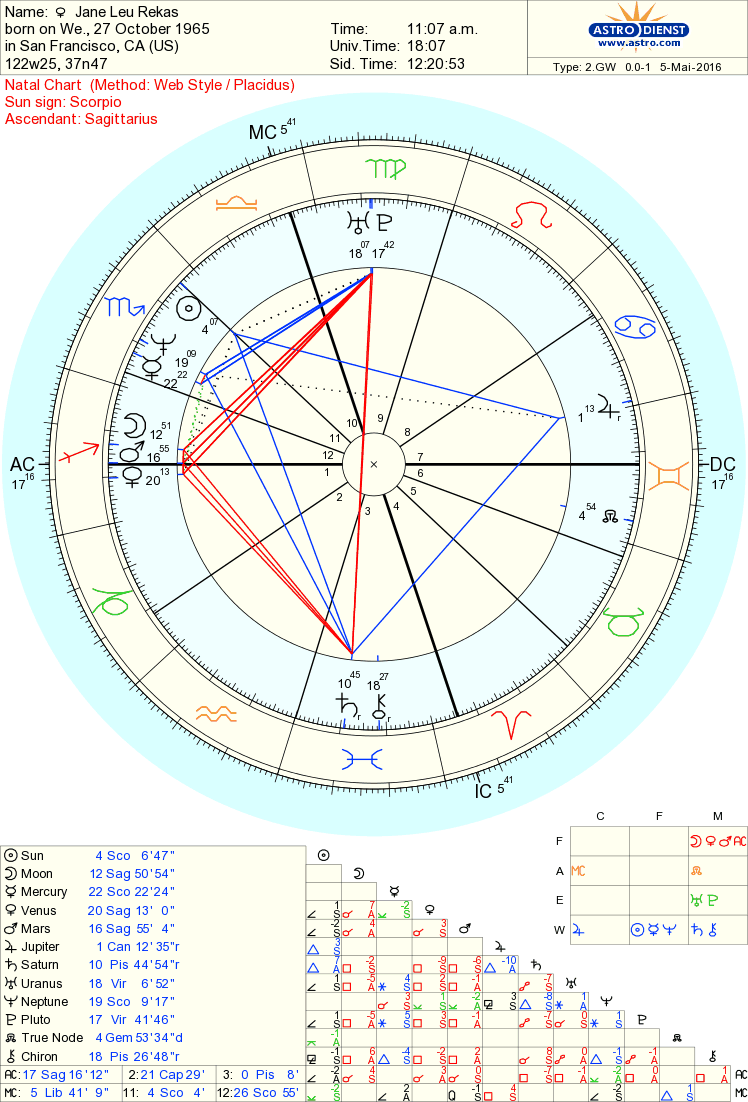
Choose the type of chart you want, in this case the default, Natal Chart Wheel:
 Right click to save your chart to your files: 
Natal Chart Wheel

Right Click and save the chart to your Files:
example

Also click the link "Additional Tables"
Additional Tables (PDF)

Right click and save the PDF to your files
Aspects in Natal Chart 

Symbols


Don't understand all the symbols?  
(We call them glyphs)

Introductory Astrology
Introductory Human Design
Lunation Calendars
and Calendar

FOLLOW BY FEEDBLITZ:
Your email address:


Powered by FeedBlitz 

Aspects

aspects


What are the aspects?  When we look at where planets are situated in a chart, we can begin to look at the relationships between the signs.

The harmonious relationships begin with Trines, which means the planets are in the same element, so they flow together well.

Example: planets in Fire Signs

 The challenging aspects, such as a Square, means they are not in the same element, but rather the same modality, such as all the planets that are Fixed, either Square or oppose one another.

Example: planets in Fixed Signs


aspect patterns

excerpt from astro.com

Here are some of the major aspects:

conjunction

Conjunction - 0° 

The conjunction tends to be a harmonious aspect. Its quality depends greatly on the planets involved, as well as on how close the aspect is. For example, a conjunction between the Sun and Mercury is generally regarded as harmonious. If, however, the distance between them is less than a few degrees, Mercury is said to be “burnt” or “in combustion”, with corresponding results. In general, the conjunction shows an immediate connection which usually works in one way or another. 

opposition

Opposition - 180°

Although the opposition is generally regarded as “disharmonious” or dynamic, it often has quite a motivating and energizing effect. Here too, the quality of the aspect depends on the planets involved, and on what one makes of it. On the whole, an opposition between two planets creates tension between them, often with positive results. 

square

Square - 90°

The square is regarded as a disharmonious aspect, the planets involved seem to be “blocked”. The problems that arise from the square keep on turning up, like a bad penny. The difficulty lies in trying to reconcile two forces that are trying to move in completely different directions. Usually this takes the form of desires and needs which are mutually exclusive. 

trine

Trine - 120°

The trine is a harmonious aspect, the planets involved work together in a complementary fashion, enriching one another. Trines show where our natural talents lie, whether we actually make use of them or not is up to us. 

sextile

Sextile - 60°

The sextile tends to have a harmonious effect, depending of course on the planets involved. 


Kevin Burk:

Introductory Astrology and Calendar

FOLLOW BY FEEDBLITZ:

Your email address:


Powered by FeedBlitz


Intro to Human Design


Class Workbook  download handouts


00:47 Origin 01:01 Strategy & Authority 01:20 from 7 Chakras to 9 Centers 01:41 Design & Personality Crystals 03:19 Technical information 04:45 Head Center intro 05:00 Ajna Center intro 05:15 Head Center glands and gates 05:30 Ajna Center glands and gates 06:07 Throat Center intro 06:30 G Center intro 06:49 Throat Center glands and gates 07:58 Throat Center thoughts 08:38 G Center glands and gates 10:10 Sacral Center intro 10:39 Spleen Center intro 11:13 Sacral Center glands and gates 12:26 Spleen Center glands and gates 13:15 Spleen Center fear gates 13:44 Ego Center intro 14:08 Ego Center glands and gates 14:43 Solar Plexus intro 15:10 Root Center intro 15:33 Solar Plexus glands and gates 16:20 Root Center glands and gates
1:40 Four Main Aura Types 2:44 Generator Aura Type 3:28 Manifesting Generator subtype 3:49 Sacral Authority 4:35 Emotional Authority 5:06 Projector Aura Type 5:33 Projector Authority types 5:52 Emotional or Splenic authority 6:33 Ego-Projected and Self-Projected authority 7:00 Mental Authority 7:19 Manifestor Aura Type 7:38 Emotional or Splenic authority 8:17 Ego-Manifested authority 8:27 Reflector Aura type 8:50 Lunar authority
What is Human Design? 

Body Graph / Rave Chart 

The Human Design System was channeled by Ra Uru Hu in 1987 in Ibiza, off Spain. Listen to more in video (left). My post on "What is Human Design?" (Further history outside link)

Symbol Key Download


The Human Design Body Graph, aka Rave Chart, is an image of your 9 centers (evolved from 7 chakras) and which are open and which are not, thus defined. Get yours at: jovianarchive.com TUTORIAL Human Design Hawaii videos on centers Listen to more in video (left).
Aura Types 

The Aura Types:
  • GENERATORS
    • Manifesting Generators
  • PROJECTORS
  • MANIFESTORS
  • REFLECTORS
(AURA TYPES outside link) Human Design Hawaii videos on auras Listen to more in video (left).
Authority/Strategy 

Your Authority is essentially the center that you will rely upon to make decisions.  Your strategy involves how you approach making decisions. (How to make correct decisions.         outside link) Listen to more in video (left).
Planets in Gates

The centers are connected by channels. The ends of the channels are gates, which are numbered.  If a gate number is highlighted, it means this is where you have a planet. Listen to more in video (left). (http://loveyourhumandesign.com/gates/)

INTRODUCTION TO RELATIONSHIPS IN HUMAN DESIGN


 Jane Rekas, LCSW, CHt is a Licensed Clinical Social Worker and Certified Hypnotist, also an Astrologer and Reiki Master. 

Human Design Chart

Get a Rave chart here:
https://www.geneticmatrix.com
http://mybodygraph.com